“I didn’t mean to,” she said immediately. “I swear I didn’t even know what it was. I found something in the bag you gave me last year, and—”
I lifted a hand gently. “You’re not being punished.”
She swallowed hard. “But the alert…”
“That’s why you’re here,” I said. “Not because you’re in trouble. Because you touched something you didn’t understand.”
She stared at the steel drive I placed on the table. “What is it?”
“A federal node,” I said. “An entry point into Echo operations.”
Her brows knit. “Echo. You mean from the base rumors — the ghost division?”
I almost smiled. “Something like that.”
I turned the drive over in my palm. “You didn’t trigger a breach, Cara. You stepped on a landmine someone else buried years ago.”
“Who?” she whispered.
“Curtis Vaughn,” I said. “Former contractor. He built parts of the interface system. I flagged him for unauthorized code injections five years back. He was removed. Or so we thought.”
Major Shaw cleared her throat. “We believe he hid dormant scripts inside backup servers. Traps. When your sister accessed the drive, she activated them.”
Cara’s face drained. “So, I did this.”
“No,” I said firmly. “He did this. You just uncovered what he left behind.”
She nodded slowly, processing. “What happens now?”
“You help fix it,” I said. “With me.”
She blinked. “Me? Help you?”
“You touched the node. You saw the logs. And you’re smart enough to learn fast.” I softened my voice. “I don’t want you punished. I want you to grow.”
Something changed in her expression — a small flicker of pride, of belief.
For the next hour, we combed through access pings, traced the false signatures, and identified the exact location where Vaughn’s traps had embedded themselves. Cara worked beside me with the intensity of someone trying to rewrite her own story. Sergeant Frey stood behind us silently, arms crossed, respecting the gravity of the situation.
When we finally cornered Vaughn’s code trail, the room felt electric.
The tribunal convened the following afternoon. It felt more courtroom than military chamber — wood paneling, rows of chairs, the air thick with unspoken tension. Vaughn stood behind the podium in civilian clothes, holding a printed report. Calm. Smug. He accused me of falsifying records in an old operation. He pointed to redacted lines. He spoke like a man performing for a jury he believed he could manipulate.
Then Sergeant Frey played the audio recording I had forgotten existed.
My voice from five years earlier, crystal clear:
“Hold fire. Possible civilian presence. Wait for recon confirmation.”
Silence swallowed the room.
Then Cara stood — hands shaking but voice steady — and presented the access log Vaughn had triggered under a fake ID, trying to rewrite history. For the first time in years, I saw truth move like a force. No shouting, no arguing. Just evidence and courage from a young cadet who wanted to do the right thing.
The tribunal cleared me without hesitation — my clearance restored, my record intact. But something mattered more. Cara walked out of the room with her head high.
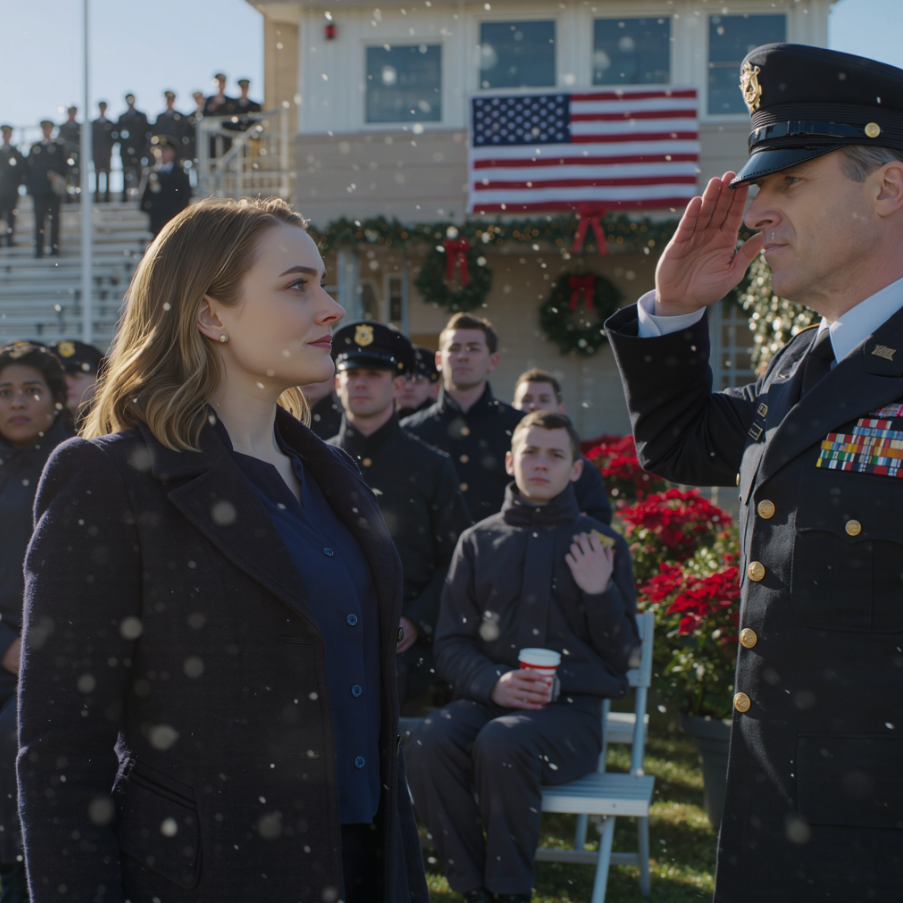
That evening, as the sun dipped behind the base, she found me near the airstrip. No medals, no applause. Just quiet. She pressed a small silver badge into my hand — a cadet leadership pin.
“I don’t want to wear it,” she said. “I want to deserve it.”
I didn’t speak. I just pulled her into a hug, holding her the way I should have years ago.
Later, in her locker, I left her a single line written on plain paper:
If you ever forget who you are, start here.
As I boarded the night transport jet, I looked back at the base — at the lights, the dust, the life I once lived between shadows. For the first time in years, I felt peace. Not because of the tribunal, not because of the truth, but because my family — my real family — finally saw me.
And maybe someday soon, the rest of them would too.
I thought that flight out of Fort Harrison would be the clean ending the story never gave me.
File closed. Record cleared. Vaughn exposed. Cara safe. Adam finally seeing a sliver of who I really was.
Neat. Contained. Manageable.
Of course, life doesn’t care about neat endings. It prefers echoes.
For a while, it really did go quiet. I went back to my office on the twelfth floor of a government building that didn’t technically exist, badged past three checkpoints, and slid into the same seat I’d left before the graduation. Six screens. One coffee mug. A stack of folders with messages that could change someone’s life if I moved them to the left instead of the right.
On paper, my job hadn’t changed. I was still Commander Cassidy Roar, Echo Division liaison to a handful of agencies that pretended they didn’t know one another. I still spent my days reading after-action reports and threat assessments written by people who’d never know my name. I still left the building each night with my shoulders tight from holding in everything I couldn’t say.
But something under the surface had shifted.
It showed up in small ways first. An email from Major Shaw with no subject line, copied to exactly no one, that contained a single sentence:
You did good work at Harrison.
For Shaw, that might as well have been a standing ovation.
It showed up in the way my secure calls with field teams hit a different register when my name came up. I would hear it in the background sometimes—
“Roar? The Roar from the tribunal?”
Echo has long memory. Rumors move faster than official cables.
I pretended it didn’t matter. I pretended I didn’t replay Adam’s words in the gas station parking lot at two in the morning when the city was finally still.
Cass, I’m proud of you.
I’d gone on missions that ended with aircraft carriers changing course and cities being quietly evacuated under the guise of faulty gas lines. I’d listened to terrified voices through static-filled comms and made decisions that would haunt me longer than any scar.
But nothing rattled me quite like my kid brother saying he was proud.
My father, on the other hand, went completely silent.
No calls. No texts. Not even one of his half-hearted “come by Sunday if you’re not too busy doing whatever it is you do now” voicemails.
At first, I told myself it was a blessing. Silence is familiar to me. I know how to move inside it.
But silence from a hostile source feels different than silence from a neutral one. My father’s silence wasn’t absence. It was pressure, coiled somewhere I couldn’t see.
I found out what he was doing with it three weeks later when my mother called.
She never phoned me from the house. She called from the grocery store, or her car, or the parking lot behind the dentist’s office. Places where the walls didn’t listen.
This time her voice was hushed and uneven.
“Your father has been… talking,” she said.
“He’s always talking,” I replied, leaning back in my office chair, staring at the reflection of my own face in the dark screen across from me.
“About you,” she clarified.
