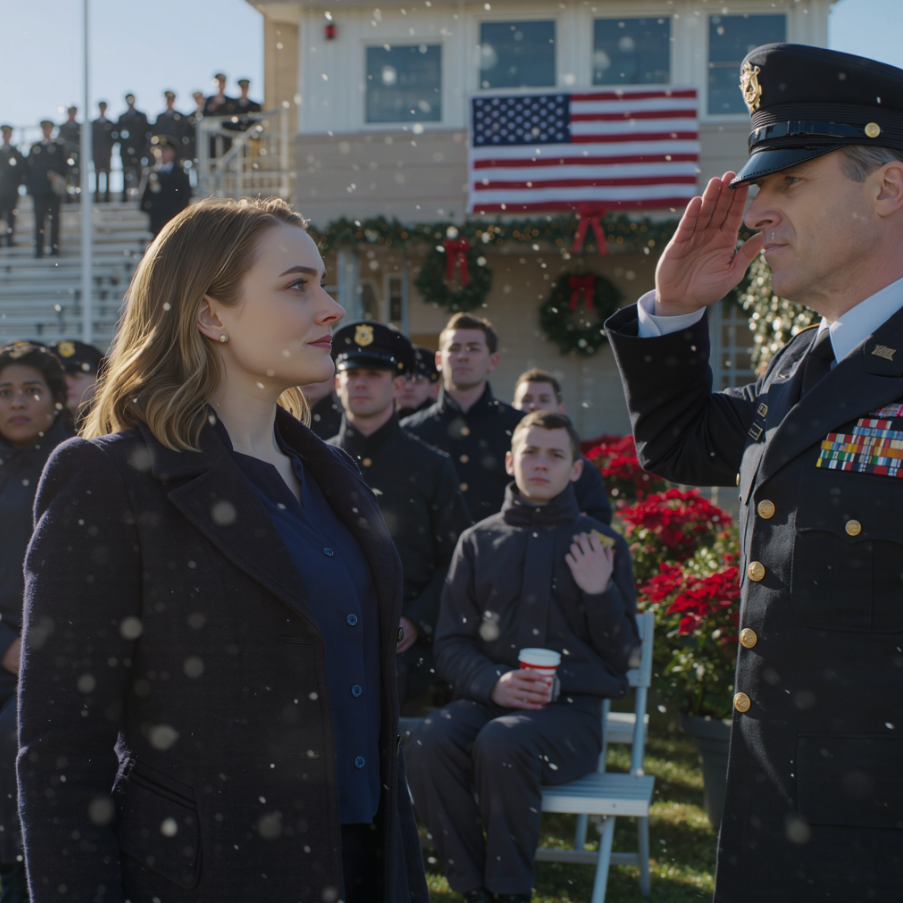
“I know.”
“I thought you couldn’t handle it.”
“I know.”
“And all this time you were what? CIA? Military intel? Some black ops thing? What are you, Cass?”
For a moment, I didn’t speak. Revealing even a fraction of my past felt like peeling away armor I’d welded to my skin.
“I served,” I finally said. “Just not the way you did.”
“That’s not an answer.”
“It’s the only one I can give.”
Silence settled again, but this time it wasn’t heavy. It was searching. He rubbed a hand over his face.
“Why didn’t you tell me? I’m your brother. I would have believed you.”
“You think that,” I said gently. “But you grew up in their house. You grew up hearing their version of me. You grew up believing their definitions of strength.”
His jaw clenched. He didn’t argue. He couldn’t.
I turned toward him. “Adam, if I had told you the truth — even a sliver of it — it would have put you in danger. There are files you aren’t cleared to see. Missions you aren’t meant to know existed. And it’s not because you’re weak. It’s because the people who survive this kind of work survive because no one knows their names.”
“And you’re one of them,” he whispered.
I didn’t nod. I didn’t smile. I didn’t deny it either. I just let the silence be the confirmation.
He exhaled shakily. “All those years, Dad said you were a disappointment. You let him.”
“He needed a story,” I said. “And I needed silence.”
“But he humiliated you.”
“I survived worse.”
He swallowed hard. “Does Mom know?”
“No.”
“Will you tell her?”
“No.”
He nodded slowly, understanding even if it hurt.
“So, what am I supposed to do? How am I supposed to pretend I didn’t see a sergeant treat you like his superior officer?”
“You’re not supposed to pretend,” I said. “You’re supposed to keep doing your job. Serve the way you were meant to. And let me keep serving the way I was.”
He looked down at his hands — steady, calloused, disciplined hands.
“My whole life,” he said, “I wanted to be like you.”
That caught me off guard.
“You were brave first,” he continued. “When you left ROC, I thought you quit. But now I’m thinking you walked into something the rest of us couldn’t even imagine.”
I didn’t respond. I didn’t know how.
Then he turned toward me fully, the question forming in his expression before he spoke it aloud.
“What really happened back then? That night they said you froze. That night everything changed.”
A cold wind swept across the parking lot, lifting dust into small spirals. For a moment, the weight of seven years pressed against my ribs.
“There was a drill,” I said quietly. “And a mistake. And afterward, someone noticed something in me. Something I didn’t understand at the time. Something that made them take me somewhere else. Not because I failed. Because I didn’t.”
He was silent a long while. Then he whispered, “Cass, I’m proud of you.”
The words settled inside me like warm ash — soft, heavy, unexpected.
Almost on cue, my secure device vibrated again. Another message.
Begin trace immediately. Internal node ping. Potential breach.
Adam saw the faint glow from the pocket of my coat. “What’s that?” he asked.
“Work,” I said. “And I need to go.”
He nodded, opened the door, then paused before stepping out. “Will I see you tomorrow?”
“You will.”
He gave a small smile, uncertain but hopeful. “Good.”
He shut the door gently and walked back to his truck. I watched him pull away, watched his tail lights fade into the night. Only then did I grip the device, read the message again, and feel the truth settle like a stone in my stomach.
A breach at Fort Harrison tonight — and whoever triggered it had used a signature tied to me.
The message glowed in my hand like a small, dangerous truth.
Begin trace immediately. Internal node ping. Potential breach.
A breach wasn’t unusual. A breach tied to me was.
I pulled out of the gas station lot and headed back toward Fort Harrison, the road stretching empty before me. The stars above looked cold, distant, like a row of silent witnesses. My tires hummed against the asphalt, a steady rhythm that helped me focus. I wasn’t afraid — Echo training drills fear out of you early — but there was a knot in my stomach that knew this wasn’t a random incident.
Someone had poked the wrong section of the wrong system, and the signal traced back to a node that hadn’t been touched in five years. Someone had reached into a part of my past I had left sealed.
The base was quieter than before when I arrived. Late-night drills had ended. Floodlights dimmed, the air heavy with desert chill. I flashed my clearance badge at the checkpoint and was waved through without question. Most guards assume civilian analysts are harmless. Most guards would be wrong.
The operations wing sat at the far end — a squat concrete structure with no windows and no signage, the kind of building that pretends it doesn’t exist. When I stepped inside, the air smelled faintly of burnt coffee and old paper files. A junior officer looked up, startled to see someone at this hour. But the moment I showed my badge, he stood straighter and led me to a small briefing room.
Major Evelyn Shaw was already there, seated at the head of the table. Her expression was the same as ever — unreadable, razor sharp, no patience for theatrics. The kind of woman whose silence could slice steel.
She slid a data pad across the table toward me.
“Commander Roar,” she said. “We traced the activation.”
Her tone wasn’t accusing. It was worse — clinical.
I sat down, my fingers brushing the data pad.
Source: Fort Harrison barracks. Civilian proxy signature.
It triggered an Echo oversight alert.
Of course it did. Because the proxy signature wasn’t random. It was mine.
Shaw watched me closely. “Is there anything you want to tell me before we proceed?”
“No,” I said. “But I’ll tell you everything after.”
She nodded, tapping the pad. The screen lit up with scrolling lines of code and timestamps.
“This wasn’t a hostile actor,” she said. “Accidental access. Someone stumbled into something they shouldn’t have.”
The words hit harder than expected. Accidental.
There was only one person who had physical access to the device capable of triggering that signature.
Cara — my brother’s bunkmate, my sister in every way except blood. The kid I used to babysit. The girl who admired me long before she understood what I became.
I stood. “Bring her in.”
When Cara entered the room a few minutes later, she looked exactly like a model cadet — spine straight, uniform crisp, jaw tight. But her eyes… her eyes told the real story. Fear, confusion, shame, and underneath it all, a kind of desperate curiosity.
She sat when I gestured. Her hands shook slightly as they clasped together.
