Not a request. Not a warning. A directive.
I closed my hand around the device and stared into the dark yard. The porch light flickered above me, casting jerky shadows across the cracked wooden boards. Somewhere inside the house, my father laughed — a loud, booming sound he saved for moments he believed he had something worth celebrating.
The contrast between that joy and the message glowing in my palm was almost surreal.
I stood up from the metal folding chair and took a long breath. The air smelled like propane and cinnamon. My childhood in two scents. I slipped the device back into the hidden pocket and stepped quietly off the porch.
No one noticed. No one ever did.
The gravel crunched under my shoes as I walked to the car. I didn’t bother saying goodbye. There wasn’t anything to say. Not yet.
By the time I reached the end of the street, the message had already expanded into a full directive:
Return to Fort Harrison. Observation shift. Initiate passive assessment. Contact not required.
I turned onto the highway, headlights cutting through long stretches of empty road. The sky had turned deep blue, almost black, with stars scattered unevenly across it. I kept both hands on the wheel, my mind already shifting into operational mode. The emotions of the dinner — the humiliation, the dismissal — they all faded as the mental muscle memory of years in Echo took over.
This was familiar terrain. Mission first. Everything else later.
The entrance to Fort Harrison was quiet when I approached. Late night shifts always were. The guards at the gate didn’t look twice at me. Civilians came and went frequently enough that no one asked why someone would be arriving at almost 10 p.m. My clearance badge, tucked neatly inside my jacket, carried a serial code no one on their level could decrypt. That was the nature of Echo. You were both visible and invisible, depending on who was looking.
I parked in the far lot, not because I needed to hide, but because habit runs deeper than comfort. The night air was cooler here, the desert wind brushing against my blouse, tugging at the ends of my hair. The distant clatter of metal rang across the grounds — a late-night equipment drill. Recruits never slept as much as they hoped.
As I walked through the south gate, I kept my steps even, deliberate. A few officers passed by, nodding politely, probably assuming I was some kind of contracted analyst. Most civilian specialists had a look — plain clothes, straight spine, a gaze that said they’d seen too much and weren’t impressed by very much anymore.
I fit right in.
The training ranges were alive with movement. I could see silhouettes of recruits in the lower field, lined up under floodlights that cast sharp shadows across the dust. They moved with the rough precision of people still learning how to turn their bodies into instruments. Their cadence calls echoed across the desert like ghosts of old battles.
And then I saw him.
Sergeant Mason Frey, infamous instructor, a man known for breaking down recruits and building them back up. He was pacing along the formation, barking orders with a voice that could command the wind if it felt like listening. His boots hit the ground with the kind of rhythm that etched itself into memory.
But mid-stride, he stopped. Not abruptly — more like a machine shutting down at the exact moment a foreign signal interrupts the circuit. His head turned slowly, deliberately, eyes narrowing as they scanned the bleachers.
Straight at me.
Even under the harsh lights, I could see the moment recognition hit him. It was like watching a storm roll across clear sky in an instant. His posture changed, shoulders stiffened, boots pivoted, and then he marched toward me — sharp, precise, a line of force cutting through the morning drills.
The recruits fell silent. The instructors stopped shouting. Even the floodlights seemed to hum quieter.
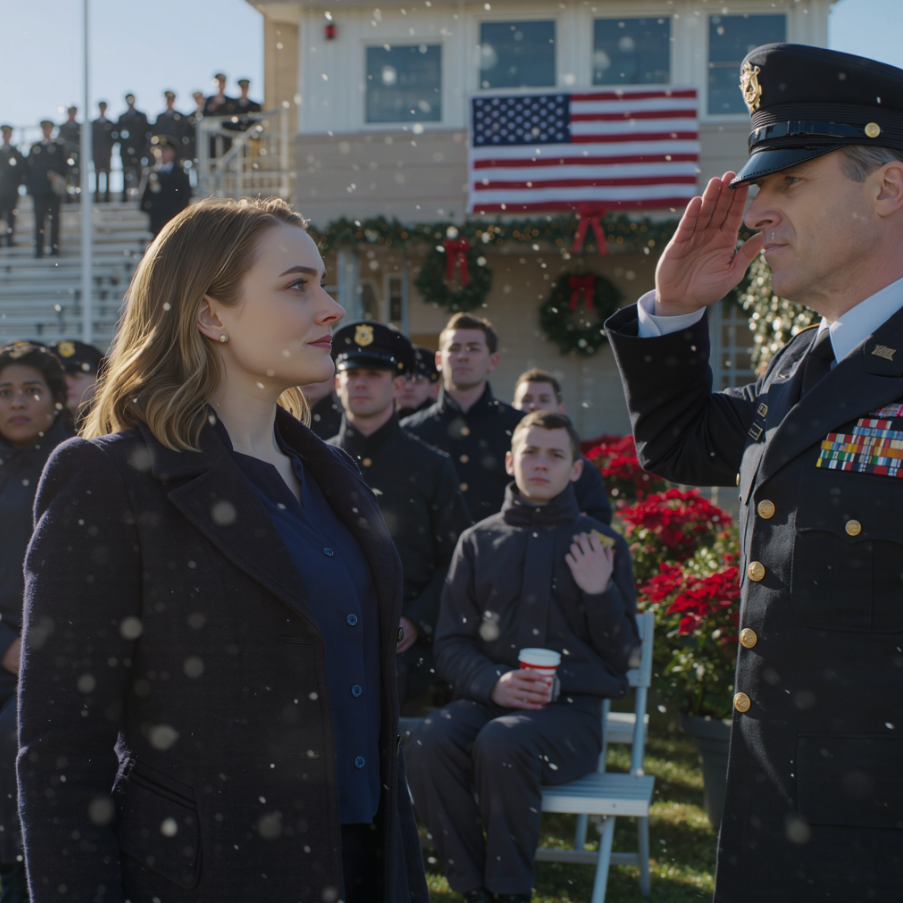
When he stopped two feet from me, he didn’t speak right away. He stood at attention, chest rising with controlled breaths. And then, with the kind of discipline they drill into soldiers from day one, he saluted.
“Commander Roar. Ma’am, I wasn’t informed you’d be observing tonight.”
My breath didn’t change. My face didn’t shift. I’d been preparing for that tone my entire adult life — though never in a place like this, never with so many eyes watching, never with family just a town away who believed I couldn’t handle discipline.
“I’m off duty,” I said evenly. “No announcement necessary. Continue as ordered.”
He dropped the salute immediately. “Yes, ma’am.”
He turned with crisp precision and walked back toward the formation, but the drills didn’t resume immediately. The silence held. Recruits shifted uncertainly. Instructors exchanged glances. Whispers slipped down the line like wildfire.
Who is she?
That’s Adam’s sister.
Why’d he call her commander?
What kind of commander doesn’t wear a uniform?
I stayed where I was, hands clasped loosely, my expression unreadable. I’d spent too long in the shadows to flinch at being exposed. If anything, the exposure felt overdue.
I watched as Adam’s unit tried to fall back into rhythm, but their movements were jagged. Adam himself stood near the front, chin lifted, posture rigid, but his eyes kept flicking toward me. Confusion, rage, betrayal — a dozen emotions collided inside him, none of them ready to be unpacked.
I didn’t stay long. Fifteen minutes at most. Long enough for whispers to turn into rumors, for officers to send curious glances toward each other, for the base to feel the tremor of a truth it couldn’t quite identify. When I finally stepped back toward the gate, the air felt heavier, charged.
I knew what would happen next. Echo signatures didn’t go unnoticed. Files would be pulled. Inquiries whispered. And my brother, who had grown up believing I abandoned everything, would now face the question he never thought to ask:
Who was I really?
As I reached my car, the night sky stretched endlessly above me. And in its quiet, I felt the weight of the story I had run from for years finally catching up to me. This wasn’t just about a salute anymore. It was about the truth coming home.
I didn’t go home right away after leaving the base. Instead, I parked in a gas station lot lit by a single buzzing fluorescent light and sat there with the engine off, keys still in the ignition, hands resting on the steering wheel. The night around me was quiet, but the kind of quiet that holds its breath — the kind that waits.
Some moments in life feel like intersections. You know that taking any step — forward, back, sideways — will reroute everything. Tonight felt like that. The salute had cracked the surface. The return to the base had widened it. And now the truth was rising through the fault lines. No matter how much I once tried to bury it.
My phone vibrated — the regular one, not the secure device. A text from Adam.
Where are you?
I stared at the screen for a long second. He’d never texted me first in his life. Not once.
I typed back two words.
Out front.
Ten minutes later, his truck pulled up beside my car. He stepped out, uniform still on, boots coated with dust, hair matted from the hours of drills he’d been leading and following. The bright recruit he used to be had sharpened into something steadier, more mature. But tonight, all of that certainty had cracked.
His face was a storm of questions.
He walked to my window, hesitated, then opened the passenger door and got in without asking. He shut the door quietly — too quietly. For a long moment, he didn’t look at me. He just breathed slow, uneven, as if trying to steady himself before jumping into water he didn’t know the depth of.
Finally, he said, “What was that?”
His voice wasn’t angry. It was wounded.
“You told us you dropped out,” he said. “You let them believe it. You let me believe it for years.”
I kept my hands folded in my lap. “Would you have believed anything else?”
He looked at me, then really looked. His eyes were red around the edges — not from crying, but from the strain of holding back a hundred questions at once.
“I deserve the truth,” he said.
“You deserve to be safe,” I replied.
He shook his head. “Cass, that doesn’t explain why a drill sergeant saluted you like he was reporting to the Pentagon. That doesn’t explain anything.”
“No,” I said softly. “But it’s where the explanation begins.”
He leaned back in the seat, staring at the gas station sign flickering above the pumps. I could tell he was reliving every story our father had ever told about me — every joke, every dig, every comparison.
“I thought you quit,” he whispered.
