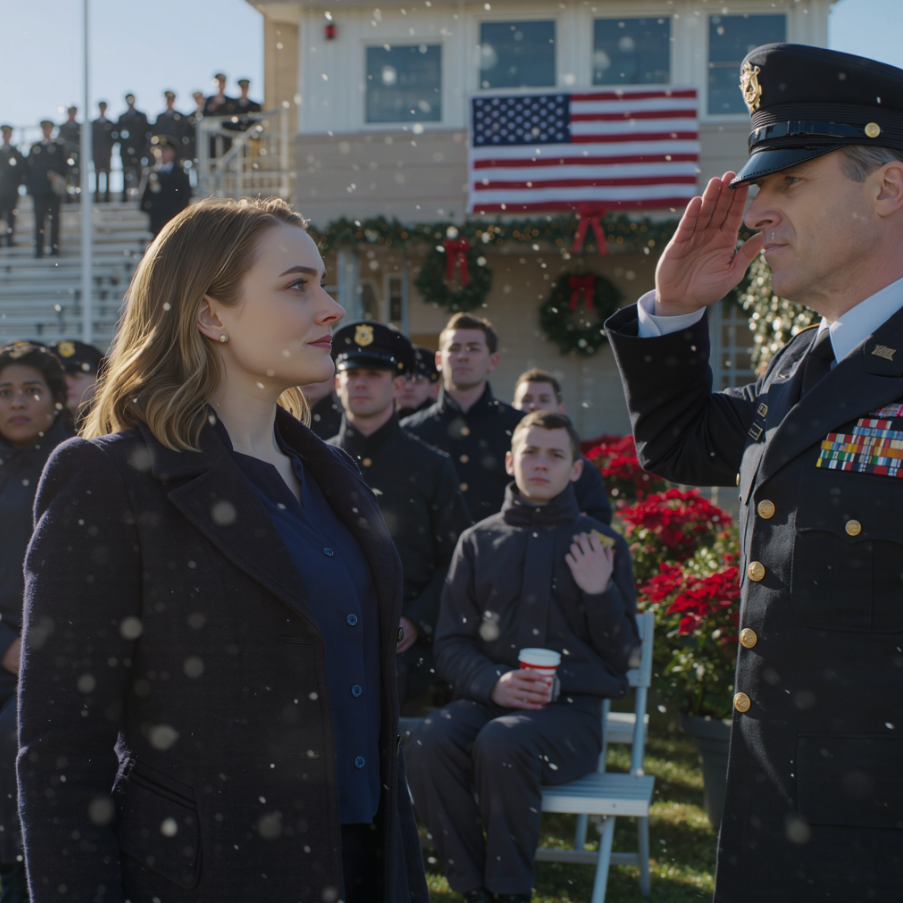
That kind of recognition lives in sealed files, top-floor meetings, chain-of-command pages no one else sees. Which meant whatever I’d hoped to keep separate — my service, my past, my silence — had collided with my family in the most public way possible.
As I drove home from the gravel turnout, the sky shifting from noon blue to dusty gold, I knew something had begun. Not Echo work. Not federal assignments. Something more personal.
I had gone dark for years. But after this morning, the shadows were stepping into the light, whether I wanted them to or not.
I drove home slower than usual, partly because the roads in our town were never meant for speed, and partly because I knew what waited for me. Not danger. Not duty. Something harder: family. And the kind of family gathering where you walk in already bracing for impact, where every word, every look, every gesture has history behind it — sharp-edged, unfinished history.
By the time I pulled into my parents’ driveway, the sun was lowering behind the old pecan trees, casting long shadows across the cracked cement. That driveway had been cracked since I was eight. My father always said he’d fix it next payday, but next payday never came. Some things stay broken because fixing them would force a man to admit they matter.
The house looked exactly the same as when I left it years ago: the faded paint, the leaning mailbox, the porch light that flickered like it was trying to remember how to shine. Even the rusted wind chimes clinked the same off-key rhythm they’d played my entire childhood.
I sat in the car for a moment after parking. Not to gather myself. That’s something people do when they’re afraid of being seen. I wasn’t afraid. I just needed a moment to shift gears from Echo silence to small-town tension. Two different war zones, each requiring its own armor.
I stepped out, straightened my blouse, and walked toward the front door. The voices inside carried through the screen — laughter, clinking glasses, the performance of a family celebration. My brother’s celebration.
I paused on the porch. The smell of baked ham and too much cinnamon hung heavy in the air. My mother always used cinnamon like it was covering something. Maybe it was.
I knocked lightly. They never locked the door anyway. My mother opened it with that tight smile she saved for guests she tolerated but didn’t love.
“You’re here,” she said. Not a hello, not a welcome — just a statement she didn’t know how to decorate.
“I am,” I answered.
She stepped aside. I walked in.
The dining room had been transformed like it was hosting a military awards banquet. A banner with “Congratulations, Adam” stretched across the back wall. Folded, printed programs sat neatly at each place setting like this was the graduation ceremony’s afterparty. A slideshow played on the television — Adam at boot camp, Adam in uniform, Adam saluting, Adam with instructors, Adam smiling, surrounded by applause.
I scanned the walls. Not one photo of me. Not even an old one. Not even something from childhood.
I wasn’t angry — just reminded. Some families frame their pride. Mine framed their narrative.
Adam spotted me first. He looked surprised, maybe even relieved. But before he could speak, my father walked up with a glass of sweet tea and that proud grin he only wore when talking about things he understood — rank, medals, achievements that could be quantified and displayed.
He didn’t hug me, didn’t shake my hand, just nodded like a man greeting an employee he didn’t remember hiring.
“So,” he said, looking back toward the slideshow, “what are you doing these days?”
I opened my mouth, but he didn’t wait for an answer.
“Adam here just finished top of his class,” he continued, patting my brother’s shoulder. “Leadership material. Real commitment. Something you can’t teach.”
My mother chimed in softly. “We’re so proud of him.”
I took the words in. Let them settle. I didn’t react. Not visibly.
My aunt Kendra, stationed near the buffet like a self-appointed guard, smirked and said, “Didn’t you used to play waitress at Applebee’s? Looks like it stuck.”
A few polite chuckles followed. Adam stiffened, but he didn’t say anything. Not yet.
I gave a small smile, measured and controlled. “I’m better at serving now,” I said calmly.
It landed the way I intended: soft enough to sound harmless, sharp enough to mean everything.
My father gestured toward the dining table. “We’re about to eat. Grab some extra forks from the kitchen, would you?”
Just like that. Default role reinstated. Invisible daughter, designated helper.
“Also, water,” someone added.
“No one else is up,” someone else said. “Cass can get it.”
There was no question of whether I minded. They assumed I would, that I should. So I went. I fetched the forks, poured the water, listened to the laughter drifting down the hallway. I caught glimpses of Adam’s face lit up on the slideshow — the golden child, the reflection of everything they wished they could claim as parenting success.
They never considered I might have fought battles they couldn’t imagine, because I didn’t fight them in the open.
When I carried the forks back, the table was full. Every seat had a name card. Every seat except mine.
My mother blinked at me as if surprised I was still in the house. “There’s a folding chair on the porch,” she said. “By the grill. You can sit there.”
So I did. I stepped out onto the porch, pulled the metal chair away from the wall, and sat with the evening wind brushing my ankles and the smell of propane drifting from the old grill. Inside, the clinking of plates and the hum of casual conversation continued without missing a beat.
But there is a kind of silence that arrives not when you are alone, but when you are unwanted — and I had lived with that silence long enough to know it intimately.
I leaned back, hands folded, listening to their voices through the thin walls — their laughter, their pride, their memories of Adam’s triumphs. They didn’t see me. They hadn’t seen me in years, maybe ever. And they thought that silence meant I had fallen apart. They thought the girl who walked out of ROC seven years ago never got back up. They thought I stayed broken. They thought I stayed small.
They had no idea that the same girl they pushed to the porch had once run operations in rooms they couldn’t enter without a federal escort. That I’d stood in places where silence wasn’t dismissal — it was survival.
From inside the house, someone said, “She should have stayed in school. Maybe she’d have made it.” Someone else replied, “Let’s not make this about her.”
I exhaled slowly — not in anger, in acceptance. I had never expected them to understand my choices. But now, after what happened at the base, I knew they were about to learn the truth, whether they wanted it or not.
As I watched the last of the sunlight disappear behind the trees, another vibration pulsed through my coat. The secure alert I’d hoped wouldn’t come until morning.
I took it out. One line glowed across the tiny screen:
Proximity activation. Echo protocol.
I sat forward. That wasn’t standard. That wasn’t routine. Something had shifted. Something had followed me home, and it was only the beginning.
The alert on my secure device didn’t buzz like a normal phone. It pulsed — a low, almost imperceptible thrum you felt more than heard, the kind that crawled under the skin and settled in the spine. Echoes — purposeful, unmistakable.
I knew before I even pulled the device from my coat that whatever peace I’d hoped to hold on to for the night had just evaporated.
Proximity activation. Echo protocol.
