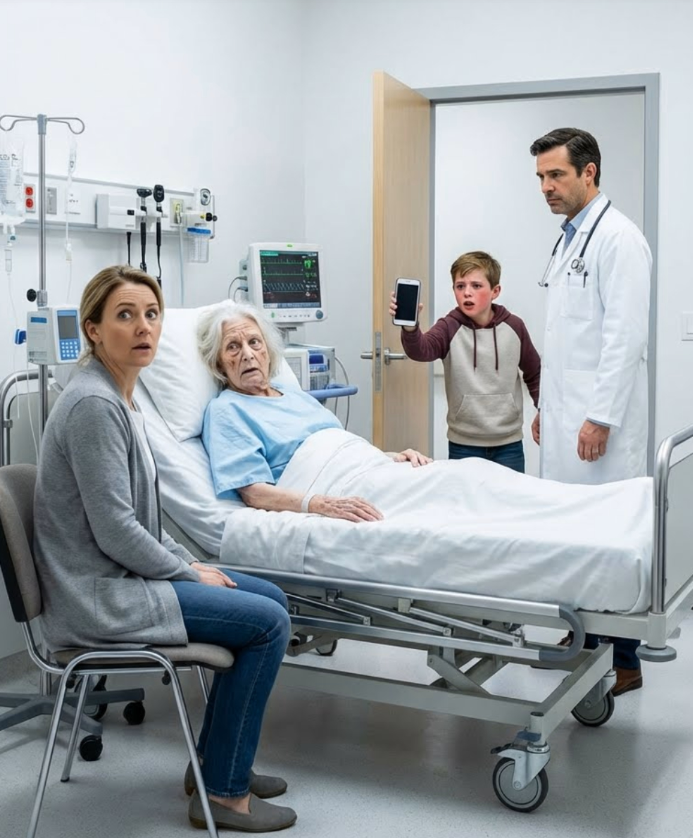
My son was dying. He needed a kidney.
My daughter-in-law looked me straight in the eyes and said, “You’re his mother. This is your obligation.”
I was already on the operating table when everything shattered.
The surgical lights burned above me like a second sun, white and merciless. The room smelled of disinfectant and cold metal. My arms were strapped down, my body rigid—not from fear alone, but from the crushing weight of inevitability.
The monitor beside me beeped steadily. Too steadily. Each sound felt like a countdown.
I could hear everything.
The soft clatter of instruments.
The rustle of gloves snapping into place.
The low murmur of voices behind the glass.
Through the frosted window, I saw Fernanda—my daughter-in-law—standing with her parents. Her arms were crossed. Her posture calm. Controlled. Commanding. She wasn’t worried.
She was waiting.
Waiting for me to disappear into surgery like a signed document.
The consent form was already done. My signature—shaking, hesitant—sat on a clipboard somewhere behind me, sealing my fate. The doctor adjusted his mask. A nurse lifted the syringe, the anesthesia glowing faintly under the light.
I closed my eyes.
I told myself this was what mothers do.
That sacrifice was love.
That giving my kidney was the last thing I could offer my son, Luis, the boy I had raised alone, protected, forgiven a thousand times.
But something inside me felt wrong.
Not fear.
Warning.
Then—
BANG.
The operating room doors flew open.
Cold air rushed in. Metal trays rattled. Every head snapped toward the entrance.
A small figure stood there, panting, eyes wide with terror.
My grandson.
Nine years old.
His voice cut through the room like glass.
“GRANDMA, STOP! PLEASE!”
The doctor froze. The nurse lowered the syringe.
Time itself seemed to stall.
The boy ran toward me, tears streaking his face.
“They’re lying to you!” he screamed.
“My dad doesn’t need your kidney because he’s sick—he needs it because he ruined his own!”
The room went dead silent.
I felt my heart slam against my ribs.
Fernanda’s face appeared at the glass—no longer controlled, no longer calm.
White.
Because in that moment, I understood something terrible.
This surgery wasn’t an act of love.
It was a cover-up.
And the truth—spoken by the smallest voice in the room—had just stopped everything.
I opened
my eyes, trying to lift my head, even though the straps held me tightly. Mario, my nine-year-old grandson, rushed in like a little whirlwind. His sneakers were caked with mud. His school uniform was wrinkled, and his chest was swollen. He was pacing up and down, panting. Behind him, a nurse…
She chased after me, terrified, screaming as she ran. “Child, you can’t come in here! Oh my God, stop!” But Mario didn’t stop.
He ran straight toward me, his big, round eyes filled with fear, but also with determination. “Grandma,” he said in a trembling voice, but so clear it broke my heart. “I should tell everyone why my dad really needs your kidney.” The whole room fell silent.
The beeping of the heart monitor was now louder, as if it wanted to tear through the air. A doctor nearby dropped a pair of surgical forceps. The sound of the metal against the marble floor was sharp, like a cut amidst the tension. I looked at Mario, my little grandson, whom I still
I used to hold him in my arms and tell him stories every night. There he was, clutching an old cell phone tightly, his face pale, but his eyes bright.
What did he know? Why was he saying that? My heart was pounding wildly, as if it wanted to burst out of my chest. I wanted to scream. To ask him right then and there. But my throat was so dry I couldn’t utter a word. Dr. Ramírez, the head of surgery, frowned. He raised a hand, making
She signaled the entire team to stop.
Her voice was deep, but sharp. “Whatever you have to say, say it now.” I saw her gaze sweep over me and settle on Mario, as if he too were trapped in that strange moment on the other side of the glass. Fernanda slammed the door, shattering the glass.
“Don’t listen to him!” she shouted in a shrill, almost hysterical voice. “He’s just a child you’re going to see.” But Fernanda’s gaze was no longer cold. It trembled with panic, as if a secret were about to be revealed. Mario didn’t look at his mother. He only looked at me, clutching his cell phone in his little hand.
So hard his knuckles turned white.
He took a deep breath, as if gathering all the courage in his life. I wanted to sit down, hold him, tell him not to be afraid, but I couldn’t move. I could only watch. And in my little grandson’s eyes, I saw a pain, a truth he was trying to bring to light. In that instant, while all
The room held its breath; memories of the past flooded my mind like an avalanche, those days when I thought my family was a closed circle, full of love and trust.
I remembered my old house, where every corner smelled of disinfectant, a smell I’d grown so accustomed to that I barely noticed it anymore. I’m 57 years old, but sometimes I feel much older. As if time has stolen my vitality a long time ago. My husband, Juan, has been bedridden for over ten years.
He sits in his old wheelchair, its wheels squeaking every time I push him out to the patio for some fresh air. He hardly ever speaks. Only occasionally does he let out a sigh, his gaze lost in nothingness. Once I took his hand and asked, “Juan, are you tired of this life?” He just
She blinked without answering. I don’t know if she understood me or if I was just talking to myself.
That house was my whole world, the place where I raised my two sons, Luis and César. I did everything to provide for them. I would get up at dawn to go to the market to sell fruit. In the afternoons, I would sit and sew clothes for the neighbors, and sometimes I would stay up until midnight mending.
torn shirts and delivered them on time. My hands became rough and calloused.
My nails were always dirty from so much digging in the market, but I never complained. I just wanted Luis and César to have a better life, not to suffer like I did. Luis, my eldest son, was my pride. He was strong, tall. He worked in construction and always came home laughing. But in
In recent years he began to weaken. At first it was just tiredness.
Then, little by little, I saw him pale, with sunken eyes. And once I felt a terrible terror when he told me he was urinating blood. I hugged him and asked, “Luis, what’s wrong, son? Tell me.” He just shook his head and smiled weakly. “Don’t worry, Mom. It’s probably from so much work.”
Fernanda, my daughter-in-law, came into our lives like a strange wind. She was beautiful. She spoke sweetly.
And at first, I truly believed she was a blessing for Luis. She took great care of him. She brought medicine home, watched over his meals, and reminded him to take his pills at the exact time. All the neighbors praised me. “How lucky you are, Doña María, with such a good daughter-in-law.” And I believed it too.
Every time I saw Fernanda give Luis a bowl of broth, I told myself I was worrying too much. But sometimes her cold, calculating gaze surprised me, as if she were hiding something. Once I saw her in the courtyard, whispering on the phone in the middle of the night, her voice low but hurried. Don’t you
Don’t worry. Everything’s going according to plan. I asked Fernanda, “Who are you calling so late?” She jumped and laughed nervously. ”
Just a friend. Mom, go to sleep now.” César, my youngest son, was different. He’s 26. He lives a few blocks from my house and works as a plumber and electrician. César doesn’t talk much, but every time he came to visit, he always brought something to eat. Sometimes oranges, other times bread.
It was still warm.
He’d sit next to me, fixing the squeaky ceiling fan or changing a lightbulb in the kitchen. Once he looked at me and said in his deep voice, “Mom, don’t kill yourself working like that. I don’t want to see you exhausted.” I just smiled and waved at him. “I can still manage, César. You worry about your…”
Brother. He needs you more. But César just shook his head, his eyes filled with worry. Mario, my little grandson, was my only joy during those difficult days.
He’s nine years old and often came to my house with his little backpack. Mario liked to sit in the yard playing with some plastic cars I bought him at the market. He would tell me stories, innocent tales that sometimes left me speechless. Once he looked at me with his round eyes and said
Grandma, my mom talks on the phone at night. I heard her say something about medicine, but I didn’t understand.
I smiled and ruffled her hair. “She was probably asking the doctor about something for your dad. Don’t worry about it so much, my child.” But inside, a seed of unease began to sprout. And then, one afternoon, everything changed. I was in the kitchen preparing dinner. The smell of toasted rice wafted through the air.
in the air. When Fernanda came in, she didn’t say hello.
She didn’t smile. She just stood there with her arms crossed. Her voice was sharp, like a razor slicing through the air. “Mom, the doctor says only her kidney is a match. It’s your responsibility. You have to save him.” I froze. The spoon I was holding fell into the pan with a
A sharp blow.
I looked at her, trying to find a glimmer of warmth in her eyes, but I only saw a cold determination, almost a demand. “Fernanda. I know. I’ll do anything for Luis,” I whispered. But my throat felt dry. She nodded as if she had achieved her goal and turned away. Not even ten minutes had passed when
Fernanda’s parents appeared. They entered my house as if it were their own.
They sat down at the dining room table and said in unison, “That’s right. A mother’s duty is something you can’t run away from. This whole family now depends on you.” I stayed there, still holding the spoon, feeling cornered. Luis, who at that moment was leaning back in a chair so
A thin man, whom I barely recognized, took my hand.
His hand was ice cold. Mama whispered, “I trust you’ll save me.” I looked into his eyes. Those eyes that, as a child, had shone with such life, and now only reflected weariness and pleading. I nodded, unable to say anything, suddenly feeling that the small room had become suffocating. The smell of herbs
The smell of medicinal herbs in Juan’s pot on the corner made me feel like I couldn’t breathe.
That night, I took Juan his bowl of soup, like every day. The creaking of his wheelchair on the cement floor was a constant reminder that I carried this entire family on my shoulders. I placed the bowl in front of him. I looked at him, but he just sighed without saying anything. I wanted to tell him,
I asked him if I was doing the right thing.
But he just stood there, motionless like a shadow. I went out to the yard where Mario was playing with his toy car. He looked up, his eyes bright but full of doubt. “Grandma,” he said. “What if someone gets sick because someone else gives them medicine?” I stopped dead in my tracks. My heart skipped a beat.
“Why do you ask that, my child?” I said, trying to stay calm. But Mario just lowered his head and kept pushing his cart without answering. What I didn’t know was that at that moment I was on the edge of an abyss and that just a few more steps would send me tumbling in. The days that followed that afternoon
When Fernanda came to my house and left me with no choice, my life felt crushed by an invisible pressure, heavier than the sweltering heat of a Mexican summer.
I continued to get up early, go to the market to sell my vegetables and oranges, and sit in the dim light sewing clothes. But my soul was no longer at peace. Every step I took, every stitch I made, carried with it a question: Am I doing the right thing? Do I really have to
Sacrifice myself like this? But then Luis’s pleading gaze, Fernanda’s sharp words, and her parents’ questioning stares clung to me, giving me no respite.
The next morning, as the sun barely peeked over the horizon, Fernanda was already at my door. She had just finished making tea. The scent of mint was only just beginning to fill the house when she came in. Without knocking, without saying hello. “Mom,” she said in a voice as firm as a nail, “the doctor says there isn’t much time left.”
If you continue to hesitate, he could be in danger.
She placed a stack of medical papers on the dining room table. White sheets filled with numbers and signatures I didn’t fully understand. She pointed to each line as if she were teaching a child. “It clearly states here that you are the only compatible donor. No one else can save him.” I stood there.
Holding the kettle, the hot water burned my fingers, but I felt no pain.
I only heard the sound of the broom scraping the cement as I began to sweep the house, a way to escape Fernanda’s gaze. “I heard you,” I said in a barely audible voice. “I’ll do anything for Luis.” But inside, a heavy rock pressed down on me, making me want to scream, want to run away. I kept going.
The sound of the broom swept away the air. It was like a mournful rhythm trying to drown out Fernanda’s words.
But she didn’t stop. She stayed there, looking at me as if waiting for me to feel it one more time to confirm that I wouldn’t dare refuse. When she left, I sat down in a chair and covered my face with my hands. I thought about Luis in the days when he was little and would run after me in the market,
clutching my skirt and laughing uproariously. ”
Mom, when I grow up I’m going to build you a really nice house.” Now he lay there, thin, pale, reduced to a shadow of his former self. I wondered if I could just let him go without doing anything, but every time I thought about donating my kidney, fear gripped me. Fear? Not of the surgery, but of the feeling of
that they were pushing me toward something bigger, darker, something I couldn’t see clearly.
That night, Fernanda’s parents arrived. They brought a basket of fruit—mangoes and oranges—but they only placed it on the table as if out of obligation and sat down in the two main chairs in the living room as if they owned the house. Her father, Mr. Carlos, coughed a couple of times.
And she said in a raspy voice, “
In my day, parents could sacrifice everything for their children. My grandmother sold all her land to save her son. Now it’s your turn. You have to do the same.” Fernanda’s mother, Rosa, nodded, her gaze as sharp as a knife. “If you dishonor this family, you will be disgraced.”
She’ll be ruined.
What will the neighbors say? They’ll say she doesn’t love her son, that she doesn’t deserve to be a mother. I sat there, gripping the edge of the table, feeling cornered in a dark corner. I wanted to say something. To ask them why the entire burden fell on me. But I couldn’t open my mouth. I just lowered my head.
And I nodded slightly, like an automaton. Dinner that night was as heavy as a funeral.
Fernanda, with feigned skill, placed a piece of chicken on my plate, but her voice was as cold as Mom’s. I saved my strength for the surgery. I stared at the chicken on my plate, but I couldn’t swallow. Luis sat across from me, his face gaunt and his eyes sunken. He tried a weak smile. “Mom, I know that…”
You’ll save me, just like you saved me all the times I was a child.
Her words were like a knife to my heart. I remembered the days when he had a high fever and I spent the night awake cleaning him with damp cloths, or the times he fell off his bike and I rushed to bandage his wounds. I was always there. I was always the mother ready to do anything.
But this time, why was she so afraid? César sat in a corner of the table, silent as a shadow. He didn’t eat. He just stirred his soup with his spoon, his eyes fixed on Fernanda. I saw his suspicious gaze, as if he were trying to see through her mask.
My daughter-in-law. I wanted to ask her, but I didn’t dare. The air in the room was thick.
All I could hear was the clinking of spoons against plates, like hammer blows to my conscience. After dinner, Fernanda got up and personally took Luis’s plate to the kitchen to wash it without letting anyone else touch it. She did it quickly, but I noticed she was examining the plate very carefully.
as if I were afraid someone might see something inside.
That night I couldn’t sleep. Lying in my old bed, I listened to the ticking of the clock on the wall. Every second, a reminder that Luis’s time was running out. I got up and walked down the hall to get a glass of water. Then I heard whispers from Fernanda and Luis’s apartment on the fourth floor. I stopped.
Standing in the darkness, holding my breath.
Fernanda’s voice was low, but clear. Yes. After the transplant, we’ll have all the data. Don’t worry. She won’t dare refuse. I stood there, my heart pounding. My hands were trembling so much I had to lean against the wall to keep from falling. Data.
What were they talking about? I wanted to knock, confront her, but just then Fernanda opened the door. She jumped when she saw me and then gave a fake smile. “Still awake, Mom? I was just calling to ask about his medicine.” I nodded and turned around, but I felt like I’d been stabbed.
Thorns in my heart. Fernanda’s smile. Her voice. Everything was fake, like a mask hiding something terrible.
The days that followed the tense conversation with Fernanda and her parents. I felt like I was living in a hazy dream where everything familiar became strange and terrifying. I continued doing my daily tasks: going to the market to sell things, sewing clothes, feeding my husband Juan. But every action was mechanical.
Soulless.
My heart was heavy, as if a dark cloud hung over my head, and Fernanda’s words, Luis’s pleading gaze, swirled in my mind, giving me no peace. But then, one afternoon, when Mario, my nine-year-old grandson, came home, the first crack appeared in the wall of
I was trying to maintain a sense of trust.
Mario came in, his sneakers stained with mud and his little hands still sticky from the paint in his art class. He left his old backpack in a corner, sat on the floor, and took out the plastic cart I had bought him at the flea market last year. I looked at him, trying to smile, but my mind was a
A tangle. Mario had always been a little light in my dark days, with his innocent stories and his crystalline laughter.
But that day he didn’t smile. He pushed the cart back and forth on the floor, his gaze lost, and suddenly he raised his head and looked at me intently. “Grandma,” he said in a low but clear voice. “What if my dad isn’t sick because of life’s circumstances, but because someone is deliberately giving him medicine?”
I jumped as if I’d been slapped.
The spoon I was holding almost slipped from my grasp, but I managed to catch it, trembling. “Why do you say that, Mario?” I asked, trying to keep my voice calm, but my heart was pounding. I looked into his clear eyes, filled with a worry that seemed too much for his age.
Mario didn’t answer right away. He lowered his head and continued playing with his toy car.
But I saw him clench his hand as if it were holding something. I wanted to hug him, ask him more, but I could only manage a nervous laugh. “You think too much, my boy. Your father is sick, and the doctors are treating him.” But my smile was forced, and Mario didn’t smile back. He just looked at me. He stood up in
Silence. He grabbed his backpack and ran home.
Mario’s question was like a stone thrown into a calm lake in my heart, creating ripples of doubt. I stayed there in my small kitchen, staring at the vegetables on the table, unable to concentrate. I thought about Luis, about the pill bottles Fernanda always brought, about how she controlled
Everything related to my son. I told myself I was probably imagining things.
Fernanda was Luis’s wife. I loved him. I wouldn’t hurt him. But deep down, I knew something wasn’t right. That afternoon it happened. César brought his toolbox, saying he was there to fix the kitchen lightbulb that had been flickering the night before.
I saw him climb the ladder, turn things around, and tighten them, and the light from the new bulb illuminated the whole kitchen. But then, as I came down with the old bulb in my hand, César looked at me with unusual seriousness. Mom said softly, almost in a whisper, “My sister-in-law is acting very strange. I saw some things in my brother’s medicine cabinet.”
unlabeled pill bottles, and she hides them very well.
I jumped and dropped the plate I was washing in the sink, splashing water on my blouse. “What are you saying?” I asked, my voice trembling. César came down the ladder and stood in front of me, his eyes filled with worry. “Mom, I’m afraid my brother’s illness isn’t normal.”
I’m afraid someone. By the way, he didn’t finish the sentence, but his look said it all.
I stood there, my hands wet, feeling like the ground was sinking beneath my feet. I wanted to scream, to tell César he was overthinking things, that Fernanda couldn’t do something so terrible. But I couldn’t speak. I just stared at César, Mario’s question echoing in my mind.
The thought echoed again. What if my dad is sick because someone is giving him medicine? I tried to dismiss it, but it clung to me like a shadow I couldn’t escape. The next day at noon, I took broth to the hospital for Luis.
The white room and the pungent smell of disinfectant made me feel like I couldn’t breathe. Luis was lying down, thin, with IVs in both arms, but he still tried to smile when he saw me. “Mom, are you home?” he said weakly.
I put the bowl on the bedside table, and just as I was about to give him the first spoonful, I saw Fernanda at the bedside holding a glass of water. She discreetly dropped a strangely colored pill into the glass. It was such a quick movement that if I hadn’t been watching closely, I wouldn’t have noticed.
I noticed. When I walked in, she jumped and spilled some water on the floor. “What pill is that, Fernanda?” I asked, trying to sound calm. She smiled, but it was forced. ”
It’s a kidney supplement. The doctor prescribed it.” I nodded, but a chill ran down my spine. I couldn’t stay calm. After Luis finished eating, I looked for the doctor on duty, a middle-aged man with thick glasses. “Doctor,” I asked, my voice trembling. “Did you…”
Did they prescribe any new kidney supplements for Luis? He was surprised and checked his chart.
No, we haven’t prescribed anything new. His current medication is sufficient. His answer froze me. I stood in the hospital corridor listening to the announcements over the loudspeaker, but my mind was blank. Fernanda had lied. What was that pill? Why did she have to hide it?
